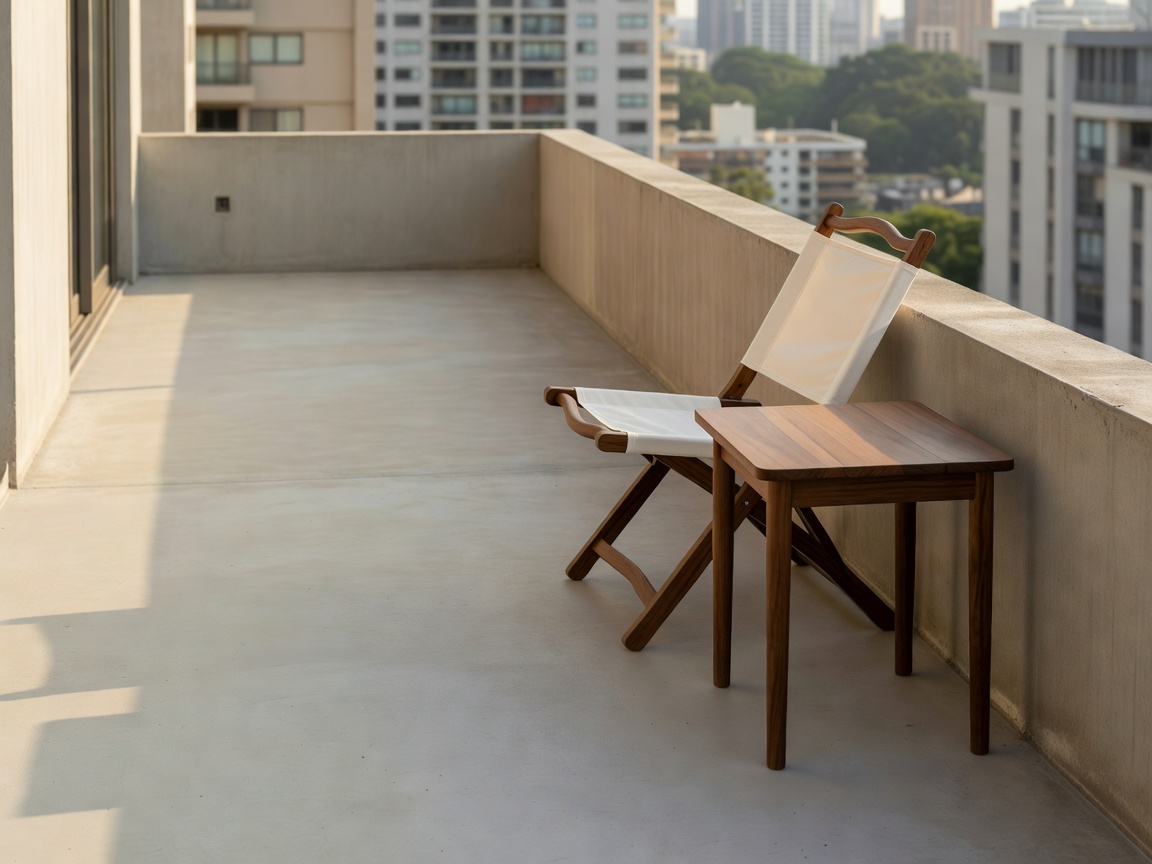
Draw what cannot move
Begin with the fixed parts: the door, threshold, guardrail, drain, wall fittings and any building-service access. Measure the usable floor rather than the outline of the balcony on a sales plan. A door opening inward or outward can change where furniture works, and a shallow recess may be too narrow once a chair’s back is included. Record these constraints before looking at products.
Make a simple paper plan and mark the route you actually use. There is no universal clearance that suits every person or balcony. Mobility aids, carrying a tray and helping a child can require more room than walking alone. Keep legally required escape and access routes unobstructed, and ask your building manager about requirements that are not obvious from the space itself.
Test a chair at full size
Use removable tape suitable for your floor, or sheets of paper that you remove immediately after the test, to mark a candidate chair’s footprint. Include arms and legs, not just the seat pad. Place an existing chair in that location if you can, then sit, stretch your legs and stand. A footprint that looks spacious from above can feel crowded the moment a person occupies it.
Next, add the table. Reach for an imaginary cup, move the chair back and carry something through the doorway. If a second person must stand up every time someone passes, the arrangement may not serve your everyday routine. It can be better to have one permanent comfortable seat and a second occasional seat than two cramped places that discourage either person from staying.
Match the seat to the evening
For a short drink after work, an upright chair and small side surface may be enough. Reading for an hour calls for more attention to back support, seat depth and where your arms rest. Dining needs a compatible table height and knee space. Do not assume that a lounge chair, café table and thick cushion will work together simply because each item is individually compact.
A narrow armchair can be easier to rise from than a very low stool, but individual needs differ. Test furniture where possible. Thick cushions change seat height and can reduce the useful depth of a shallow chair. A flexible woven seat may feel comfortable in a shop yet collect water outside. Comfort and weather performance need to be evaluated together.
Choose folding furniture for a real reason
Folding chairs are useful when the space genuinely changes function. They are less useful if opening, closing and storing them becomes a daily obstacle. Check the folded dimensions, the locking mechanism and the weight you can comfortably carry. Keep fingers clear of folding joints and follow the maker’s instructions. A chair that is awkward to secure should not be left loose in an exposed location.
Stackable seats have a similar trade-off. The stack still needs a stable storage location, and it must not obstruct access or become a climbing aid near a guardrail. Storage benches can combine jobs, but their lids need clearance and their contents still need protection from condensation. Never assume that a box advertised for outdoor use is dry enough for cushions in every climate.
Do not borrow space from the railing
Railing-hung tables look efficient, but a guardrail is a safety component, not a universal furniture support. Its design, loading and permitted attachments are matters for the building owner or a qualified professional. Ask before adding clamps, brackets, planters or screens. A fitting that appears removable can still damage finishes, interfere with inspection or change how forces act on the railing.
Keep climbable furniture away from the edge, particularly when children may use the balcony. Do not place a heavy planter or storage unit simply to hold a chair against wind. Balcony load capacity includes people, furniture and accumulated contents; it cannot be inferred safely from a photograph or the age of a building. Ask the responsible building professional when there is uncertainty.
Leave one useful patch of empty floor
Empty space makes the furniture work. It is where a chair moves, a person turns and a wet item can be carried back inside without brushing everything else. After placing the essentials, resist filling the remaining gap automatically. Live with the layout for a few evenings and note what is inconvenient. Often the best final addition is a small, reachable surface rather than another seat.
For reference, EN 581 is a European standards series covering outdoor seating and tables; it does not replace checking the intended use and instructions of a specific product. The U.S. Consumer Product Safety Commission and the Royal Society for the Prevention of Accidents publish useful household-safety material. Apply the guidance relevant to your location and household, rather than treating any label as a complete layout assessment.